Sample Research Report – Morpho
This is 1 of 100+ structured research reports produced by Quantify Crypto. Each report follows a standardized framework combining proprietary rankings, performance metrics, and ongoing updates designed to identify high-potential opportunities across the crypto market.
Reports are continuously refreshed as market conditions change.

Every cryptocurrency in our coverage universe is evaluated using a consistent methodology:
- QC Ranking – Relative strength vs. the broader market
- QC Score – Composite technical and momentum signals
- Performance Tracking – Yearly and historical returns
- Sector Classification – Identifies where capital is flowing
This standardized approach allows investors to compare opportunities across 100+ assets using the same framework.
Morpho was founded in 2021 by a team including Paul Frambot (CEO), along with co-founders including Merlin Egalite, Julien Thomas, and Mathis Gontier Delaunay. Early on, Morpho built a peer-to-peer "optimizer" layer on top of existing DeFi lending protocols like Aave and Compound. That original product was sometimes referred to as "Morpho Optimizer."
Over time, the protocol evolved: by the mid-2020s Morpho repositioned itself from simply an "overlay" to a more general "lending infrastructure." Their versioning includes "Morpho Blue" (the base lending infrastructure) and more advanced offerings.
Today, Morpho is a decentralized, non-custodial lending protocol built for Ethereum and other EVM-compatible blockchains.
While Morpho is a lending protocol, its main differentiator is a peer-to-peer (P2P) matching layer. Instead of (or before) routing supply/borrow through large liquidity pools (as Aave/Compound does), Morpho attempts to match borrowers directly with lenders. This matching can lead to more efficient capital utilization — i.e. better yields for lenders, lower borrowing costs for borrowers.
If no direct P2P match is found, Morpho falls back to using the underlying liquidity pools (e.g. Aave / Compound), preserving liquidity and guaranteeing yield — so you get the best of both worlds: optimized matching when possible, fallback liquidity when not.
Morpho also supports isolated, customizable markets. That means developers (or institutions) can spin up markets with custom collateral types, loan assets, oracles, and interest-rate models — giving flexibility and modularity beyond "one-size-fits-all" DeFi pools.
Morpho is trying to be not just a "lending app," but an underlying lending infrastructure fabric for DeFi — maximizing capital efficiency, flexibility, and composability.
Morpho experienced significant growth in 2025, driven by major integrations with platforms such as Coinbase, Crypto.com, Gemini, and Société Générale Forge, expanding its user base from 67,000 to over 1.4 million and increasing deposits from $5B to $13B. Institutional engagement accelerated, with real-world asset (RWA) deposits reaching $400M, highlighting growing adoption beyond crypto-native users. These developments reinforced Morpho's positioning as infrastructure for on-chain lending rather than a standalone application.
Following the rollout of Morpho V2 in June 2025, the protocol's focus has shifted toward scaling its role as core financial infrastructure after four years of development. A key takeaway from this evolution is that institutional adoption requires flexibility and control, particularly over risk, liquidity, and pricing. Morpho's architecture — built on composable, isolated markets — enables tailored lending strategies across different regulatory and risk environments, positioning it for broader adoption.
As DeFi matures, the protocol is emphasizing market-driven rate discovery rather than formula-based pricing, addressing a critical limitation in traditional on-chain lending models. Looking ahead, 2026 is expected to mark Morpho's expansion beyond crypto-native users, becoming more deeply embedded in traditional financial products and less visible at the user level as infrastructure powering institutional and fintech applications.
Morpho V2 introduced two core components — Morpho Markets V2 and Morpho Vaults V2 — that build on principles of previous Morpho versions, such as immutable, permissionless, and externalized risk curation, while introducing several powerful new capabilities.
Morpho Markets V2 is an intent-based primitive for peer-to-peer loans. Initially, the system will facilitate fixed-rate, fixed-term loans with customizable parameters, but it can be extended to support other loan types.
Key design considerations of Markets V2:
- Create an open & competitive market: All loan offers are broadcast to a single global market, ensuring users receive the best possible terms.
- Enable expression of intents: Lenders and borrowers can express bespoke loan offers with multiple conditions without fragmenting liquidity.
- Minimize trust assumptions: Permissionless and immutable infrastructure that executes loans without introducing additional trust assumptions.
- Piggyback on existing liquidity: For example, lenders can earn variable rates on Morpho V1 or other protocols while waiting for a loan offer to be matched on Markets V2.
Morpho Vaults V2 enables anyone to create vaults that allocate assets across any protocol to generate yield for depositors.
Key design considerations of Vaults V2:
- Future-proof: The ability to allocate to any protocol ensures that Vaults V2 are compatible with Morpho V1, Morpho V2, and Morpho's future releases, including new types of loans.
- Instant liquidity & variable rates: Vaults offer instant liquidity for withdrawals and variable yields based on the allocation to fixed-rate loans (Markets V2), variable-rate pools (Markets V1), etc.
- Enhance curator differentiation: Enables more differentiated strategies with unique risk profiles.
- Greater flexibility: Revamped role system and granular risk controls, including absolute and relative caps to manage exposure.
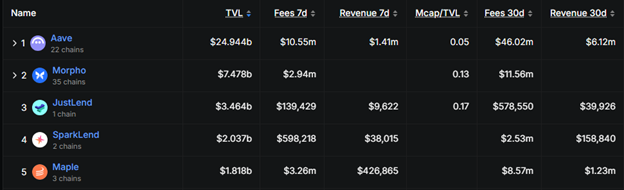
April 9, 2026 Data: Morpho is 2nd in TVL ($7.48 billion) compared to Aave ($24.94 billion). Morpho is increasing in TVL while Aave is decreasing; fees collected by both are lower, see below.
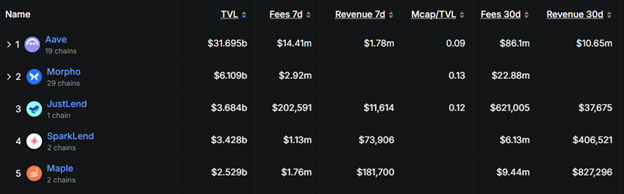
December 2, 2025 Data: Morpho is 2nd in TVL ($6.1 billion) compared to Aave ($31.7 billion).
Want access to the full research library?
View all 100+ reports, rankings, and real-time signals used to identify top-performing cryptocurrencies.
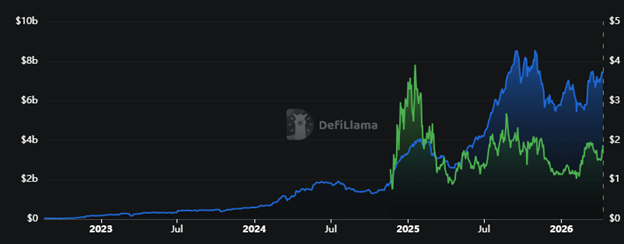
TVL Increasing: On January 1st, 2024 Morpho had a TVL of $597 million. This has increased substantially to $7.45 billion as of April 10, 2026. TVL: Blue Line — Morpho Price: Green Line
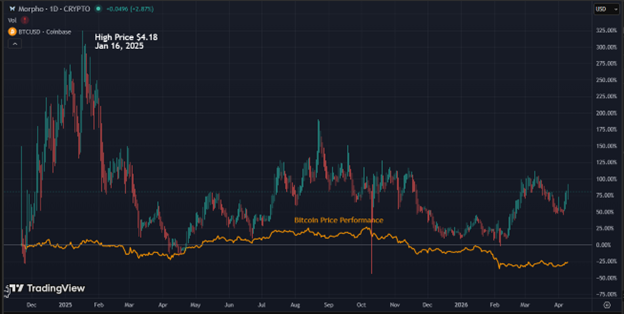
Morpho picked an excellent time to launch during the strong bull market surge at the end of 2024, rising more than 300% in under a month. Like many crypto projects in early 2025, Morpho entered a downtrend but went on to outperform Bitcoin during bullish cycles in May, July, and August. In 2026, Morpho has a year-to-date gain of 56% (as of April 10), in what has been a mostly poor performance year for most cryptocurrency projects so far.
Quantify Crypto provides rankings of the top cryptocurrencies, categorizing them into five levels: Highest, Above Average, Average, Below Average, and Lowest. Cryptocurrencies are researched and evaluated evenly, ensuring that each fundamental level contains approximately 20% of the cryptocurrencies analyzed.
Aave is a significant competitor, however Morpho has added functionality Aave does not have yet. Others in the space (Compound, Sky, and Curve to name a few) do not have a product as similar to Aave as Morpho does.
The model closely mirrors traditional secured lending, where banks issue instruments like CDBs (Certificados de Depósito Bancário) that generate predictable, collateral-backed yields. Just as CDBs rely on overcollateralization, stable interest flows, and low default risk, decentralized lending protocols use crypto collateral and automated liquidation systems to create the same risk-controlled return profile. This familiarity makes the structure attractive to investors, who see it as a blockchain-based extension of a long-proven financial model.
Morpho stands out as one of the most interesting and promising innovations in DeFi lending today. By combining a peer-to-peer matching layer with fallback to traditional liquidity pools, and supporting customizable, isolated markets, it attempts to deliver a more efficient, flexible, and "infrastructure-ready" lending solution.
Compared to Aave — the DeFi lending giant — Morpho offers potentially better yields and terms, greater composability, and a more modular approach. But with that power comes more complexity and slightly more risk.
If you believe decentralized finance will continue evolving beyond "basic pool-based lending," Morpho could be one of the protocols to watch.
Quantify Crypto provides a structured, data-driven approach to cryptocurrency investing. By combining consistent research methodology with real-time analytics, the platform helps identify market trends, sector strength, and high-potential opportunities.
This report is part of a larger system designed for active market participants seeking a disciplined edge.