OpenSea’s Token Failure: Months of Hype, Zero Delivery
John Barry | Tue Mar 17 2026
OpenSea’s Token Misstep: A Lesson in Execution vs. Expectation
In a move that has frustrated much of its user base, OpenSea has effectively pulled back on its anticipated token launch after months of building expectations through gamified engagement. The reasoning—“market conditions may not be right”—has landed poorly with a community that has already invested significant time, capital, and trust into the process.
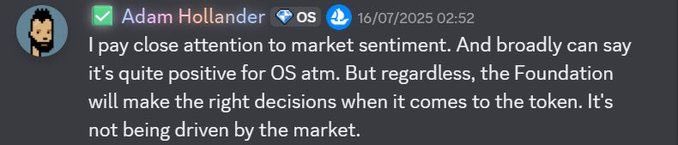
A year ago, messaging from the OpenSea Foundation indicated that market conditions would not dictate whether a token launch would proceed. Today’s reversal directly contradicts that position, highlighting a pattern of shifting narratives.
Over the past several months, OpenSea introduced multiple waves of so-called “treasure chests,” encouraging users to actively trade NFTs, generate volume, and pay platform fees in anticipation of a future token distribution. For many participants, this was not passive engagement—it involved deliberate strategy, repeated transactions, and in many cases meaningful financial outlay. Users weren’t just clicking buttons; they were buying NFTs, paying fees, and dedicating hours of effort under the assumption that these actions would be rewarded.
That is what makes today’s reversal particularly damaging. When a platform incentivizes behavior tied—implicitly or explicitly—to a future reward, it creates an expectation contract with its users. Breaking that expectation after the fact risks more than disappointment; it undermines credibility.
The Cost of “Gamified” Commitment
OpenSea’s approach leaned heavily into gamification without delivering closure. The treasure chest system created tiers of engagement that required ongoing participation, effectively turning users into active contributors to platform revenue. The longer the campaign ran, the more users committed—both financially and psychologically.
This is not just a marketing misstep. It raises a broader issue within crypto: platforms must be careful when designing incentive systems that blur the line between engagement and promised rewards. If users feel they have been “strung along,” trust erodes quickly—and in crypto, trust is often the only durable moat.
A Stark Contrast: Uniswap’s Launch
The situation stands in sharp contrast to one of the most respected token launches in crypto history—Uniswap.
Uniswap’s 2020 token launch was almost the opposite of OpenSea’s approach:
-
No extended hype cycle
-
No gamified preconditions
-
No months-long user “qualification” process
Instead, Uniswap executed a clean, surprise airdrop to past users. Those who had simply used the protocol—without expectation—were rewarded. The result was one of the most positively received launches in crypto history, with immediate goodwill and long-term brand strengthening.
Uniswap didn’t ask users to perform tasks for months. It simply recognized prior participation and delivered value.
Execution Matters More Than Timing
OpenSea’s justification—market conditions—misses the deeper issue. Crypto markets are always volatile. Waiting for perfect conditions is rarely a viable strategy, particularly after months of user conditioning.
More importantly, execution consistency matters more than timing perfection. By signaling one direction for months and then reversing course at the final stage, OpenSea has introduced uncertainty where there should have been clarity.
The Bigger Risk: Eroding User Trust
For OpenSea, the real damage is not the delayed token—it’s the potential loss of user confidence.
Users who:
-
traded extensively
-
paid fees repeatedly
-
engaged deeply with the platform
may now question whether future incentives will be honored. That hesitation can directly impact platform activity, liquidity, and long-term relevance in an increasingly competitive NFT and digital asset landscape.
Final Thoughts
OpenSea remains one of the most recognized platforms in the NFT ecosystem, but this episode highlights a critical lesson: in crypto, how you launch matters just as much as what you launch.
A token can always be delayed.
Trust, once lost, is far harder to rebuild.
If OpenSea intends to move forward with a token in the future, it will need more than improved market conditions—it will need a clear, transparent, and user-aligned approach that restores confidence.
Because in today’s market, users aren’t just participants—they are stakeholders. And stakeholders remember how they were treated.