Not Every Token Qualifies: Inside Quantify Crypto’s Crypto Selection Process
John Barry | Fri Aug 28 2026
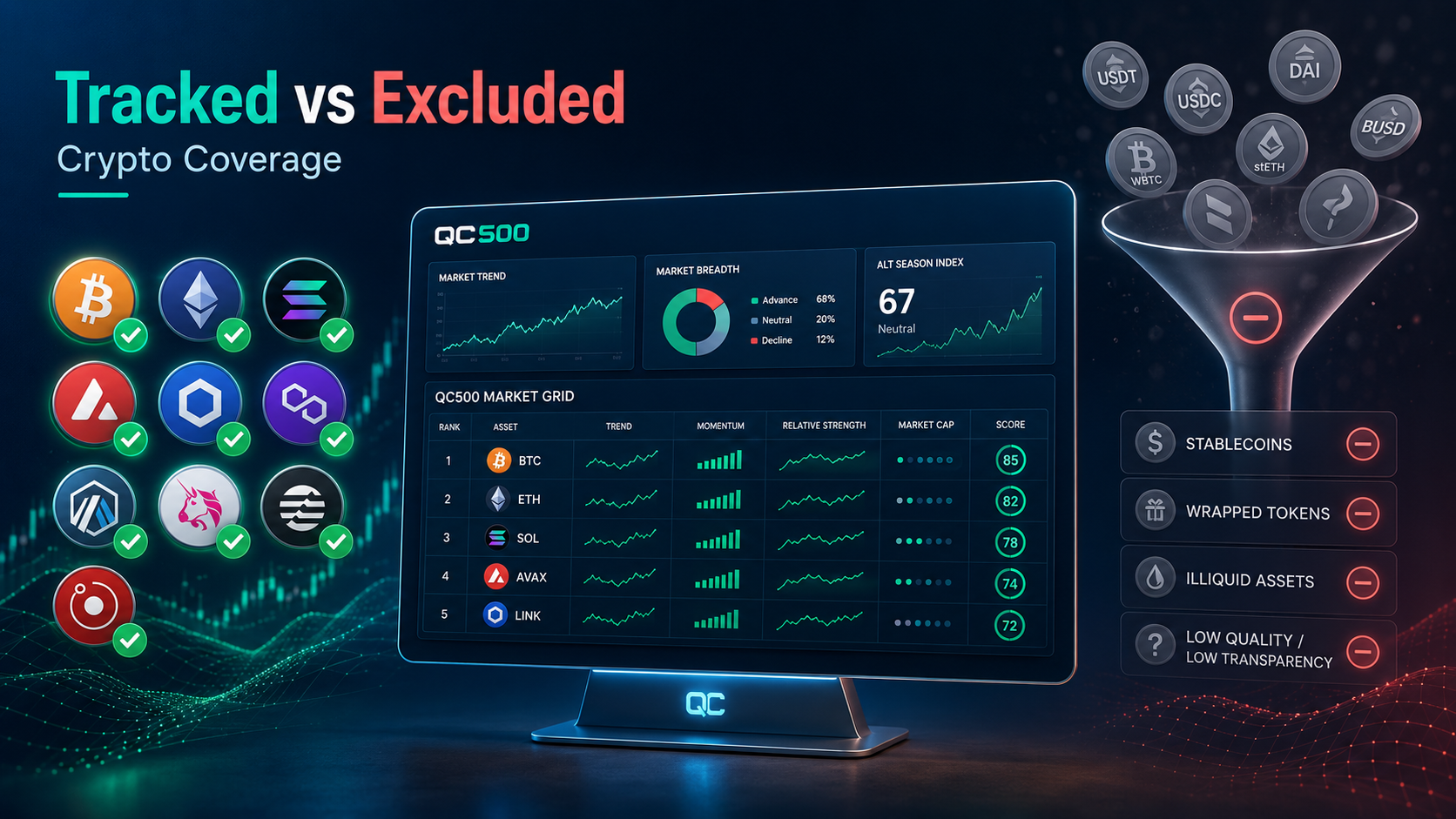
There are more than 30,000 cryptocurrencies in existence, but simply having a token and a market price does not make a cryptocurrency suitable for meaningful investment analysis. Quantify Crypto takes a more selective approach, tracking approximately 500 cryptocurrencies that meet specific liquidity, exchange-listing and asset-type requirements. These cryptocurrencies make up the QC500 Index and are used throughout Quantify Crypto's screeners, heatmaps, technical metrics, signals and market-sector analysis.
The objective is not to include every token that can be traded. Instead, Quantify Crypto focuses on cryptocurrencies where reliable market data and sufficient trading activity make technical analysis more meaningful. The QC500 is an equally weighted index, so each of the 500 projects has the same influence on the index regardless of market capitalization. This makes the QC500 particularly useful for measuring the performance of the broader cryptocurrency market rather than allowing Bitcoin and a handful of very large projects to dominate the results. See the Quantify Crypto Markets page for more details https://quantifycrypto.com/markets
What Cryptocurrencies Are Included?
Quantify Crypto tracks approximately 500 cryptocurrencies, ranging from established projects such as Bitcoin, Ethereum, XRP and Solana to smaller and newer altcoins that meet its eligibility requirements. Coverage is not determined strictly by market capitalization. Instead, Quantify Crypto applies several fundamental filters before adding a cryptocurrency.
The first major requirement is trading volume. A cryptocurrency normally needs average daily trading volume of at least $250,000. Liquidity is extremely important for Quantify Crypto because many of its metrics are based on technical price analysis. A token that trades only a few thousand dollars per day can experience enormous price changes from a relatively small transaction, making technical indicators far less reliable and increasing the possibility of price manipulation.
The second requirement is a listing on a recognized centralized cryptocurrency exchange, or CEX. Major exchanges conduct their own project reviews before listing an asset, providing an additional level of screening. Quantify Crypto does not consider an obscure decentralized-exchange listing by itself sufficient evidence that a project should be included among the 500 cryptocurrencies it actively analyzes.
Projects meeting these requirements can come from virtually every major area of cryptocurrency. Quantify Crypto currently organizes the market into sectors including Currency, Platform, DeFi, Exchange, Meme, Game, NFT, Metaverse, AI and Services. Each cryptocurrency is placed into the sector that most closely reflects its primary function, even when the project could reasonably fit into several categories. Ethereum, for example, is classified as a Platform cryptocurrency even though ETH is also widely used as a currency.
Why Doesn't Quantify Crypto Simply Track Every Cryptocurrency?
More coverage does not necessarily produce better analysis.
Thousands of cryptocurrencies have extremely low trading volume, limited liquidity, very small numbers of holders or little meaningful exchange activity. A token may technically have a quoted price while only a few transactions occur each day. Under those conditions, a $10,000 or $20,000 trade could dramatically alter the reported market price.
This matters when calculating indicators such as Trend, RSI, MACD, Bollinger Bands, support and resistance, trading volume and other technical measurements used by Quantify Crypto. These tools work best when price discovery occurs through an active market with enough buyers and sellers to produce meaningful data.
For this reason, Quantify Crypto deliberately chooses quality of market data over the number of tokens displayed.
Which Tokens Are Not Included?
Several major categories are deliberately excluded from Quantify Crypto.
Stablecoins are not included. Assets such as USDT and USDC are designed to maintain a value near $1.00. Since their purpose is price stability rather than price appreciation, applying momentum and technical-trading analysis to them provides relatively little value. A properly functioning stablecoin should have very little price movement.
Wrapped cryptocurrencies are also excluded when they simply duplicate the economic exposure of an asset already being tracked. For example, Bitcoin is included, but Wrapped Bitcoin does not need to be independently represented in the QC500 because WBTC is intended to closely follow Bitcoin's price. Including both would effectively count the same underlying asset twice.
Staked versions of existing cryptocurrencies are treated similarly. A liquid-staking token whose price is primarily derived from another cryptocurrency generally does not represent an independent cryptocurrency investment for purposes of the QC500.
Tokens without sufficient trading volume are excluded as well. A project could have interesting technology, a large stated market capitalization or considerable social-media attention, but if average daily volume does not meet Quantify Crypto's approximately $250,000 threshold, its price data may not be reliable enough for inclusion.
Finally, projects that trade only on small decentralized exchanges and have not achieved a qualifying centralized-exchange listing generally aren't included. Quantify Crypto explicitly tells users searching for unsupported assets that eligible tokens need both meaningful trading volume and a listing on a leading CEX.
A Large Market Capitalization Does Not Automatically Qualify a Token
Market capitalization by itself can sometimes be misleading.
Consider a token with 1 billion tokens outstanding and a reported price of $1.00. On paper, that gives the project a $1 billion market capitalization. But if only $50,000 worth of the token trades each day, there may not be enough liquidity for investors to actually buy or sell meaningful quantities anywhere near that $1 price.
This is one reason Quantify Crypto places considerable emphasis on trading volume and exchange availability rather than simply selecting the 500 largest reported market capitalizations.
The QC500 therefore should not be confused with a conventional "Top 500 by Market Cap" list. It represents approximately 500 cryptocurrencies selected by Quantify Crypto after applying its market-quality filters.
New Cryptocurrency Projects Can Be Added
The QC500 is not a permanent list. The cryptocurrency market changes constantly. New projects launch, existing projects gain exchange listings and trading volume, while older projects can lose liquidity or relevance. Quantify Crypto reviews the universe of available cryptocurrencies and can replace projects as market conditions change.
The QC100 components, for example, are reviewed and updated monthly, while the broader QC500 represents the approximately 500 projects currently selected for tracking. Additionally there is a research report for each crypto project that makes up the QC100 index. https://quantifycrypto.com/info/cryptocurrency-research-reports
This also means a cryptocurrency that isn't currently supported isn't necessarily being judged as a poor project. It may simply not yet satisfy the requirements needed for inclusion.
A newly launched cryptocurrency may have excellent technology but insufficient trading history. Another may have adequate volume but still trade primarily on decentralized exchanges. If those conditions change, the project could subsequently become eligible for Quantify Crypto coverage.
Why the Filtering Matters
Quantify Crypto's goal is not to produce the world's longest cryptocurrency list. The goal is to maintain a broad but investable universe where market statistics can be analyzed consistently.
The approximately 500 selected cryptocurrencies provide enough breadth to capture movements across large-cap assets, emerging altcoins, DeFi, AI, meme coins, gaming, exchanges and other sectors without allowing thousands of illiquid or duplicate tokens to distort the results.
That is particularly important for the QC500. Because every cryptocurrency receives an equal weighting, including hundreds of thinly traded projects would substantially reduce the usefulness of the index as an indicator of broader crypto-market conditions.
By excluding stablecoins, wrapped and staked duplicates, illiquid tokens and projects without sufficient centralized-exchange support, Quantify Crypto attempts to create a cleaner representation of the actively traded cryptocurrency market.
The Bottom Line
A cryptocurrency generally needs to satisfy three basic conditions to be considered for Quantify Crypto:
- Meaningful trading liquidity, normally averaging at least $250,000 per day.
- Trading on a recognized centralized cryptocurrency exchange.
- An independently traded cryptocurrency rather than a stablecoin, wrapped token or staked duplicate of another asset.
Meeting these standards does not mean Quantify Crypto is recommending that cryptocurrency as an investment. Inclusion simply means the asset has sufficient market activity and characteristics to be tracked and analyzed alongside the other cryptocurrencies within the Quantify Crypto system.
That distinction is important. With thousands of cryptocurrencies available, deciding which assets have sufficiently reliable markets to analyze is the first step. Determining which of those projects represents an attractive investment comes afterward.